Hi,
I am working on modeling Protein A affinity PCC chromatography. Since I am not very familiar with SMB Builder, I tried using the scheduling method.
Expected result:
I was expecting a proper elution for different cycles.
Output:
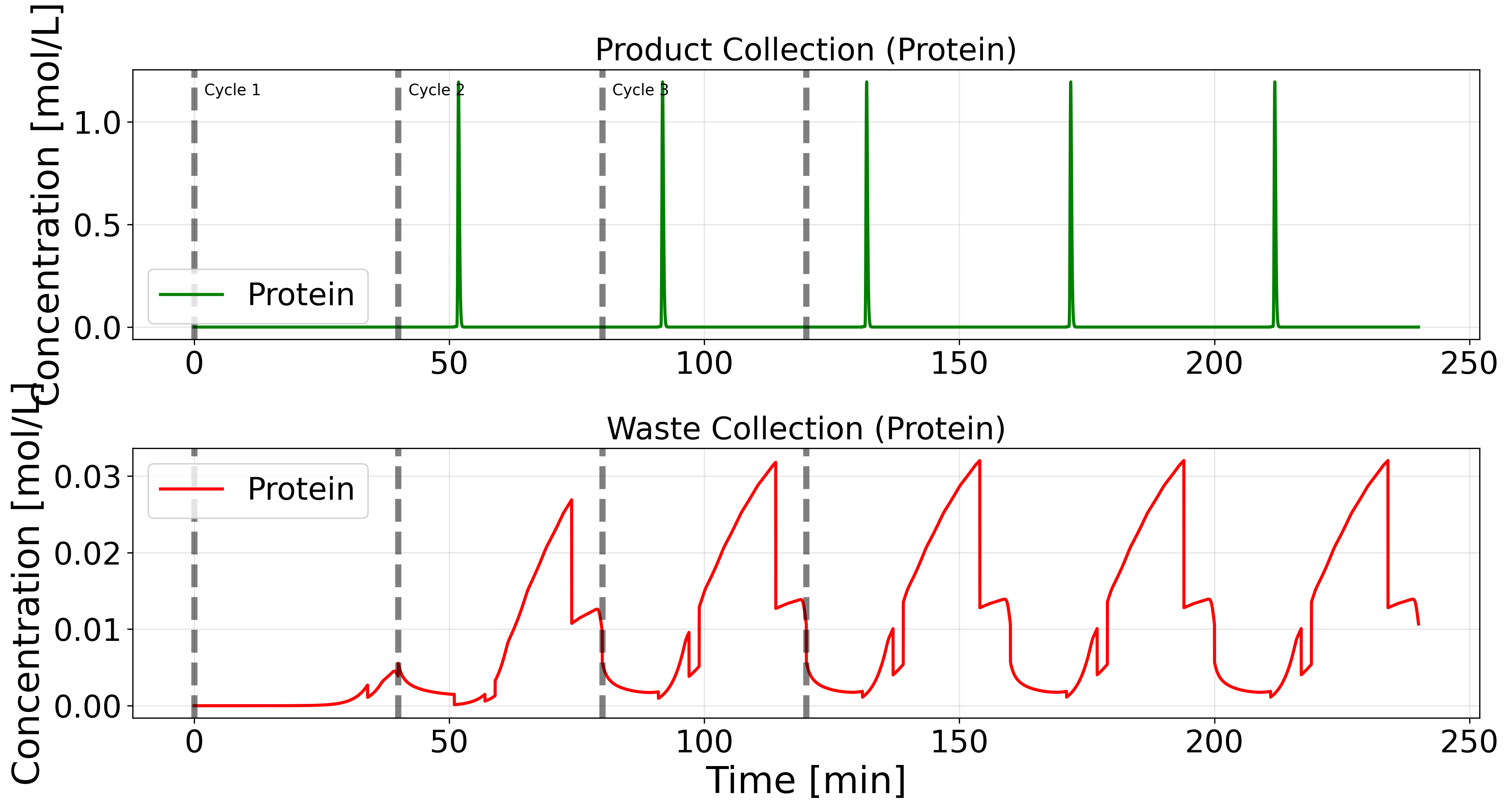
Minimum reproducible code:
from CADETProcess.processModel import ComponentSystem, Inlet, Outlet, GeneralRateModel
from CADETProcess.processModel import FlowSheet, Process
from CADETProcess.processModel import MobilePhaseModulator
from CADETProcess.simulator import Cadet
import numpy as np
import matplotlib.pyplot as plt

def create_pcc_process():

    CYCLE_TIME = 40 * 60

    load_time = 37 * 60  # 37 minutes
    wash_zone1_time = 3 * 60  # 3 minutes

    # Zone 3 timings - total 40 minutes
    t_w1 = 1 * 60  # 1 minute
    t_w2 = 4 * 60  # 4 minutes
    t_w3 = 6 * 60  # 6 minutes
    t_elute = 6 * 60  # 6 minutes
    t_clean1 = 2 * 60  # 2 minutes
    t_pause = 15 * 60  # 15 minutes
    t_clean2 = 1 * 60  # 1 minute
    t_equil = 5 * 60  # 5 minutes

    mLmin_to_m3s = 60 * 1e6
    FLOW_LOAD = 3.03 / mLmin_to_m3s
    FLOW_OTHER = 4.55 / mLmin_to_m3s

    # pH and concentration parameters
    mol_wt = 146.5
    conc = 5.3
    conc_load = conc / mol_wt  # mol/L

    pH_bind = 7
    pH_elute = 3.5
    pH_b_H = 10**(-pH_bind)
    pH_e_H = 10**(-pH_elute)

    #components
    sys = ComponentSystem()
    sys.add_component('Salt')
    sys.add_component('Protein')

    #binding model
    binding_model = MobilePhaseModulator(sys, name='MPM')
    binding_model.is_kinetic = False
    binding_model.adsorption_rate = [0, 5.19e-08]
    binding_model.desorption_rate = [0, 1.0]
    binding_model.capacity = [0, 10]
    binding_model.ion_exchange_characteristic = [0, 1.54]
    binding_model.hydrophobicity = [0, 0]
    binding_model.bound_states = [0, 1]

    #Inlets
    feed = Inlet(sys, 'feed')
    feed.c = [pH_b_H, conc_load]

    wash_z1 = Inlet(sys, 'wash_z1')
    wash_z1.c = [pH_b_H, 0]

    wash1 = Inlet(sys, 'wash1')
    wash1.c = [pH_b_H, 0]

    wash2 = Inlet(sys, 'wash2')
    wash2.c = [pH_b_H, 0]

    wash3 = Inlet(sys, 'wash3')
    wash3.c = [pH_b_H, 0]

    eluent = Inlet(sys, 'eluent')
    eluent.c = [pH_e_H, 0]

    cip = Inlet(sys, 'cip')
    cip.c = [10**(-3.0), 0]

    equil = Inlet(sys, 'equil')
    equil.c = [pH_b_H, 0]

    #columns
    cols = []
    for i in range(3):
        column = GeneralRateModel(sys, name=f'col_{i+1}')
        column.length = 0.058  # m
        column.diameter = 0.01  # m
        column.bed_porosity = 0.899998
        column.particle_porosity = 0.49956
        column.particle_radius = 50e-6
        column.axial_dispersion = 9.21e-7
        column.film_diffusion = [1e-4, 9.93e-5]
        column.pore_diffusion = [1e-9, 9.54e-11]
        column.binding_model = binding_model
        column.discretization.ncol = 50
        column.discretization.npar = 12
        column.c = [pH_b_H, 0]
        cols.append(column)

    #Outlets
    product = Outlet(sys, 'product')
    waste = Outlet(sys, 'waste')

    #flowsheet
    fs = FlowSheet(sys)

    for u in [feed, wash_z1, wash1, wash2, wash3, eluent, cip, equil, product, waste]:
        fs.add_unit(u)
    for c in cols:
        fs.add_unit(c)

    #connections
    # Connect ALL inlets to ALL columns
    for inlet in [feed, wash_z1, wash1, wash2, wash3, eluent, cip, equil]:
        fs.add_connection(inlet, cols[0])
        fs.add_connection(inlet, cols[1])
        fs.add_connection(inlet, cols[2])

    # Col1 output states: [product, waste, col_2]
    fs.add_connection(cols[0], product)
    fs.add_connection(cols[0], waste)
    fs.add_connection(cols[0], cols[1])

    # Col2 output states: [product, waste, col_3]
    fs.add_connection(cols[1], product)
    fs.add_connection(cols[1], waste)
    fs.add_connection(cols[1], cols[2])

    # Col3 output states: [product, waste, col_1]
    fs.add_connection(cols[2], product)
    fs.add_connection(cols[2], waste)
    fs.add_connection(cols[2], cols[0])

    #Process
    process = Process(fs, 'PCC_Chromatography')

    #total process time
    process.cycle_time = 3 * CYCLE_TIME

    #add events for all 3 phases
    def add_phase_events(state_idx):
        """
        state 0: Load C1->C2, Recover C3 (0-40 mins)
        state 1: Load C2->C3, Recover C1 (40-80 mins)
        state 2: Load C3->C1, Recover C2 (80-120 mins)
        """
        t_base = state_idx * CYCLE_TIME

        #[to_column1, to_column2, to_column3]
        to_c1 = [1, 0, 0]
        to_c2 = [0, 1, 0]
        to_c3 = [0, 0, 1]

        if state_idx == 0:
            load_dest = to_c1
            rec_inlet_map = to_c3
            rec_col_name = 'col_3'
        elif state_idx == 1:
            load_dest = to_c2
            rec_inlet_map = to_c1
            rec_col_name = 'col_1'
        else:
            load_dest = to_c3
            rec_inlet_map = to_c2
            rec_col_name = 'col_2'

        #LOADING (0-37 min): Z1
        process.add_event(f'S{state_idx}_load_start', 'flow_sheet.feed.flow_rate', FLOW_LOAD, t_base)
        process.add_event(f'S{state_idx}_load_dest', 'flow_sheet.output_states.feed', load_dest, t_base)

        if state_idx == 0:
            process.add_event(f'S{state_idx}_c1_conn', 'flow_sheet.output_states.col_1', [0, 0, 1], t_base)  # C1->C2
            process.add_event(f'S{state_idx}_c2_conn', 'flow_sheet.output_states.col_2', [0, 1, 0], t_base)  # C2->Waste
        elif state_idx == 1:
            process.add_event(f'S{state_idx}_c2_conn', 'flow_sheet.output_states.col_2', [0, 0, 1], t_base)  # C2->C3
            process.add_event(f'S{state_idx}_c3_conn', 'flow_sheet.output_states.col_3', [0, 1, 0], t_base)  # C3->Waste
        else:
            process.add_event(f'S{state_idx}_c3_conn', 'flow_sheet.output_states.col_3', [0, 0, 1], t_base)  # C3->C1
            process.add_event(f'S{state_idx}_c1_conn', 'flow_sheet.output_states.col_1', [0, 1, 0], t_base)  # C1->Waste

        #WASH (37-40 min): Z1
        t_chase = t_base + load_time
        process.add_event(f'S{state_idx}_load_stop', 'flow_sheet.feed.flow_rate', 0.0, t_chase)
        process.add_event(f'S{state_idx}_z1w_start', 'flow_sheet.wash_z1.flow_rate', FLOW_LOAD, t_chase)
        process.add_event(f'S{state_idx}_z1w_dest', 'flow_sheet.output_states.wash_z1', load_dest, t_chase)

        # Stop
        process.add_event(f'S{state_idx}_z1w_stop', 'flow_sheet.wash_z1.flow_rate', 0.0, t_base + CYCLE_TIME)

        #Z2: RECOVERY STEPS
        cur_t = t_base

        def set_rec_out(time, dest_type):
            vec = [0, 1, 0] if dest_type == 'waste' else [1, 0, 0]
            process.add_event(f'{rec_col_name}_out_{state_idx}_{int(time)}',
                            f'flow_sheet.output_states.{rec_col_name}', vec, time)

        #Wash 1
        process.add_event(f'w1_start_{state_idx}', 'flow_sheet.wash1.flow_rate', FLOW_OTHER, cur_t)
        process.add_event(f'w1_dest_{state_idx}', 'flow_sheet.output_states.wash1', rec_inlet_map, cur_t)
        set_rec_out(cur_t, 'waste')
        cur_t += t_w1
        process.add_event(f'w1_stop_{state_idx}', 'flow_sheet.wash1.flow_rate', 0.0, cur_t)

        #Wash 2
        process.add_event(f'w2_start_{state_idx}', 'flow_sheet.wash2.flow_rate', FLOW_OTHER, cur_t)
        process.add_event(f'w2_dest_{state_idx}', 'flow_sheet.output_states.wash2', rec_inlet_map, cur_t)
        cur_t += t_w2
        process.add_event(f'w2_stop_{state_idx}', 'flow_sheet.wash2.flow_rate', 0.0, cur_t)

        #Wash 3
        process.add_event(f'w3_start_{state_idx}', 'flow_sheet.wash3.flow_rate', FLOW_OTHER, cur_t)
        process.add_event(f'w3_dest_{state_idx}', 'flow_sheet.output_states.wash3', rec_inlet_map, cur_t)
        cur_t += t_w3
        process.add_event(f'w3_stop_{state_idx}', 'flow_sheet.wash3.flow_rate', 0.0, cur_t)

        #Elution
        process.add_event(f'elute_start_{state_idx}', 'flow_sheet.eluent.flow_rate', FLOW_OTHER, cur_t)
        process.add_event(f'elute_dest_{state_idx}', 'flow_sheet.output_states.eluent', rec_inlet_map, cur_t)
        set_rec_out(cur_t, 'product')
        cur_t += t_elute
        process.add_event(f'elute_stop_{state_idx}', 'flow_sheet.eluent.flow_rate', 0.0, cur_t)

        #Clean 1
        process.add_event(f'cip1_start_{state_idx}', 'flow_sheet.cip.flow_rate', FLOW_OTHER, cur_t)
        process.add_event(f'cip1_dest_{state_idx}', 'flow_sheet.output_states.cip', rec_inlet_map, cur_t)
        set_rec_out(cur_t, 'waste')
        cur_t += t_clean1

        #Pause
        process.add_event(f'pause_start_{state_idx}', 'flow_sheet.cip.flow_rate', 0.0, cur_t)
        cur_t += t_pause

        #Clean 2
        process.add_event(f'cip2_start_{state_idx}', 'flow_sheet.cip.flow_rate', FLOW_OTHER, cur_t)
        cur_t += t_clean2
        process.add_event(f'cip2_stop_{state_idx}', 'flow_sheet.cip.flow_rate', 0.0, cur_t)

        #Equilibration
        process.add_event(f'eq_start_{state_idx}', 'flow_sheet.equil.flow_rate', FLOW_OTHER, cur_t)
        process.add_event(f'eq_dest_{state_idx}', 'flow_sheet.output_states.equil', rec_inlet_map, cur_t)
        cur_t += t_equil
        process.add_event(f'eq_stop_{state_idx}', 'flow_sheet.equil.flow_rate', 0.0, cur_t)

    # Add events
    add_phase_events(0)
    add_phase_events(1)
    add_phase_events(2)

    print(f"\nProcess created with {len(process.events_dict)} events")

    return process


def run_pcc_simulation():

    process = create_pcc_process()

    simulator = Cadet()
    simulator.evaluate_stationarity = True
    simulator.n_cycles_max = 1
    simulator.n_cycles_min = 1
    simulator.timeout = 3600  # 1 hour timeout

    try:
        simulation_results = simulator.simulate(process)
        print(f"Simulation completed successfully!")
        print(f"Cycles simulated: {simulation_results.n_cycles}")
        return process, simulation_results
    except Exception as e:
        print(f"Simulation failed with error: {e}")
        import traceback
        traceback.print_exc()
        return process, None


def plot_results(process, simulation_results):

    if simulation_results is None:
        print("No results to plot")
        return

    try:
        fig, axes = plt.subplots(2, 1, figsize=(14, 8))
        fig.suptitle('PCC Chrom Process', fontsize=16)

        # Plot Product outlet
        ax = axes[0]
        if hasattr(simulation_results.solution, 'product'):
            product_data = simulation_results.solution.product.outlet.solution
            product_time = simulation_results.solution.product.outlet.time / 60
            ax.plot(product_time, product_data[:, 1], label='Protein', color='green', linewidth=2)

            # Mark cycle switches
            for i in range(4):
                cycle_start = i * 40
                ax.axvline(x=cycle_start, color='k', linestyle='--', alpha=0.5)
                if i < 3:
                    ax.text(cycle_start + 2, ax.get_ylim()[1]*0.9, f'Cycle {i+1}', fontsize=10)

        ax.set_ylabel('Concentration [mol/L]')
        ax.set_title('Product Collection (Protein)')
        ax.legend()
        ax.grid(True, alpha=0.3)

        # Plot Waste outlet
        ax = axes[1]
        if hasattr(simulation_results.solution, 'waste'):
            waste_data = simulation_results.solution.waste.outlet.solution
            waste_time = simulation_results.solution.waste.outlet.time / 60
            ax.plot(waste_time, waste_data[:, 1], label='Protein', color='red', linewidth=2)

            # Mark cycle switches
            for i in range(4):
                cycle_start = i * 40
                ax.axvline(x=cycle_start, color='k', linestyle='--', alpha=0.5)

        ax.set_xlabel('Time [min]')
        ax.set_ylabel('Concentration [mol/L]')
        ax.set_title('Waste Collection (Protein)')
        ax.legend()
        ax.grid(True, alpha=0.3)

        plt.tight_layout()
        plt.savefig('pcc_chromatography_results.png', dpi=300, bbox_inches='tight')
        print("\nResults saved as: pcc_chromatography_results.png")
        plt.show()
    except Exception as e:
        print(f"Error plotting results: {e}")
        import traceback
        traceback.print_exc()


if __name__ == "__main__":
    process, results = run_pcc_simulation()

    if results:
        plot_results(process, results)
    else:
        print("\nSimulation failed")
Kindly help me with this.
Thanks
Naveen J