Hello all,
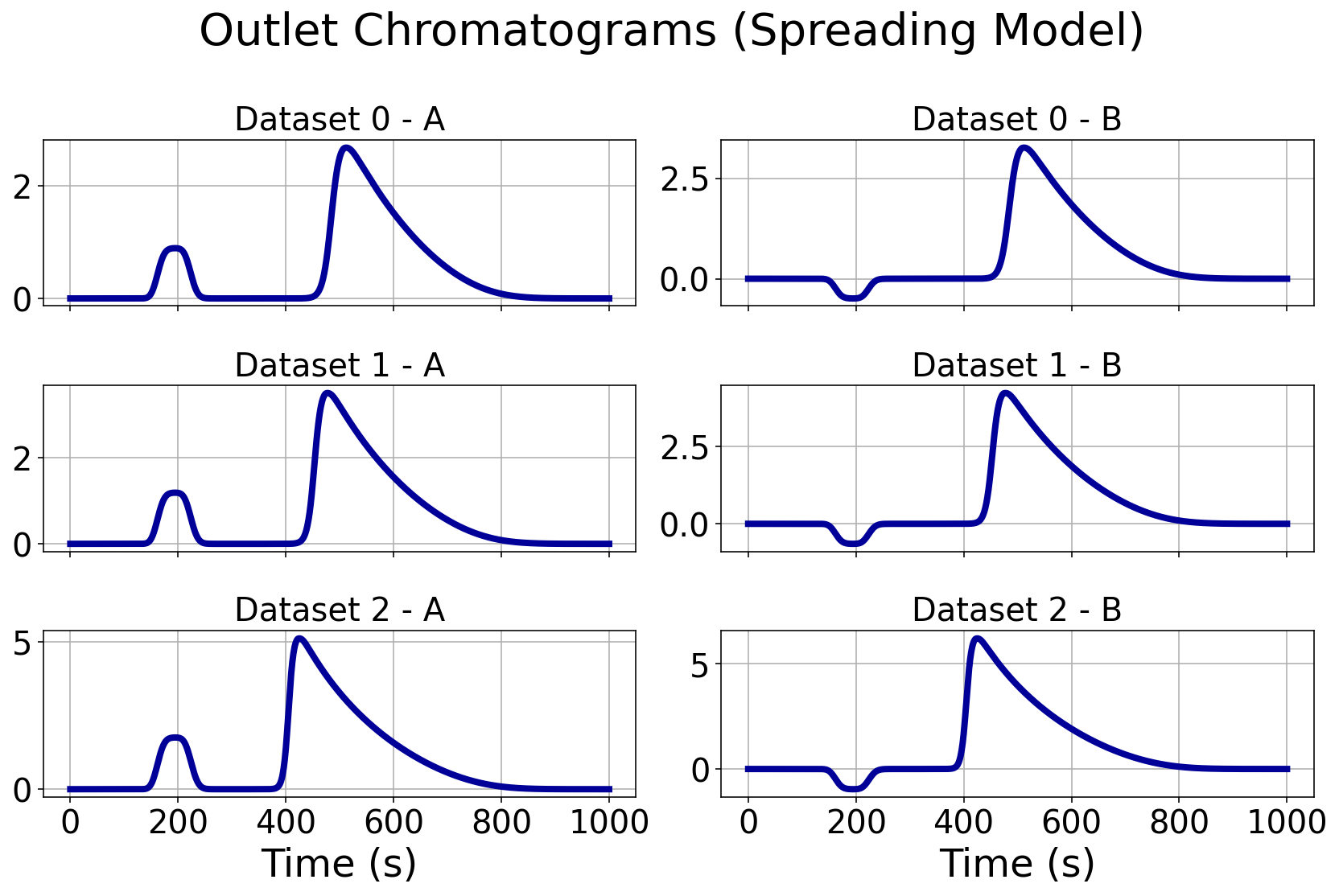
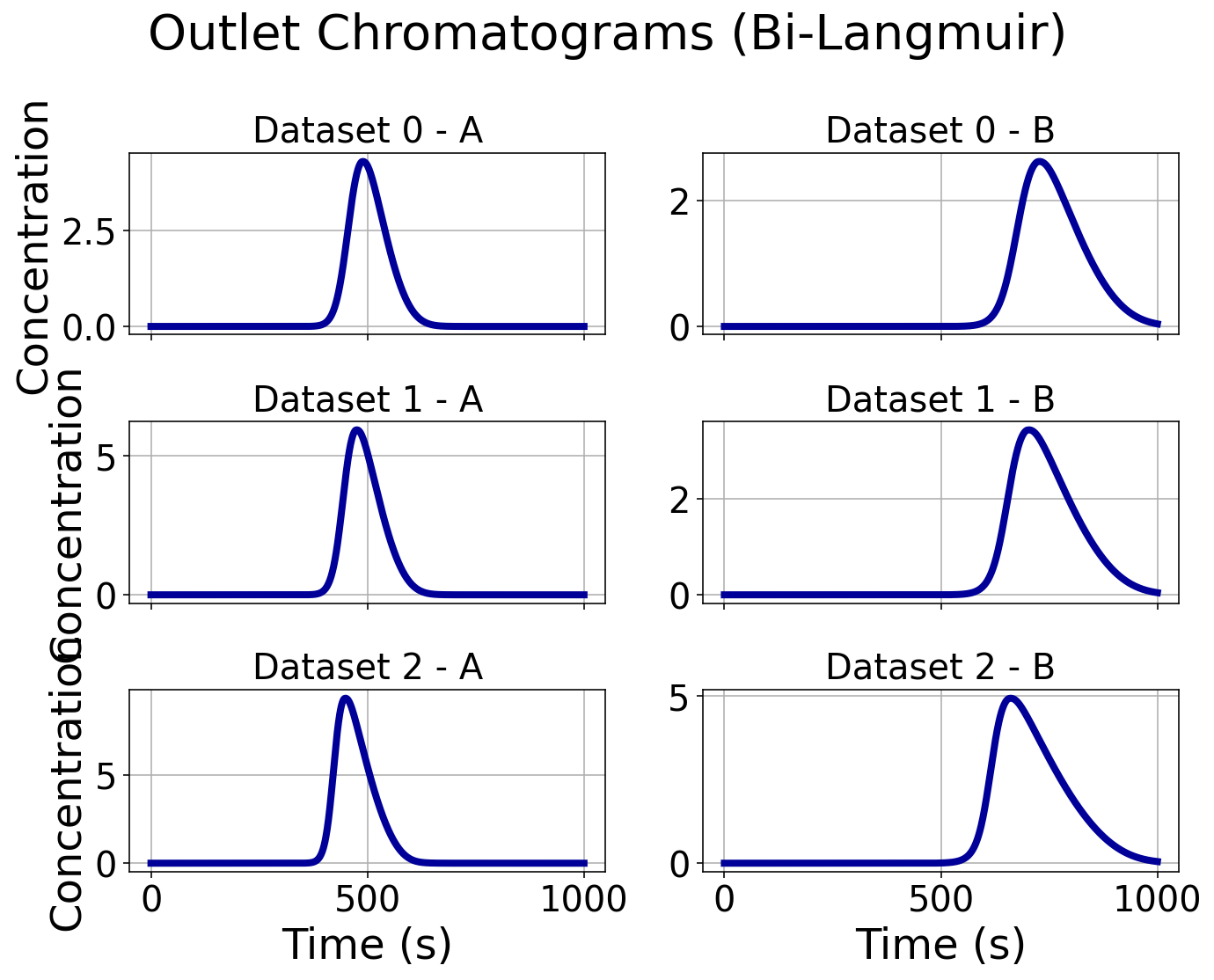
I am trying to work with the Multi-Component Spreading Binding model. My end goal is to simulate a process with 3 components (A, B, and C) however I am having issues generating results. In order to trouble-fix, I am first looking at a process with just 2 components (A and B). My main issue is I keep getting negative concentrations at the outlet, so I decided to set site exchange rate constants to 0 to allow no exchange in the hope I could replicate the results from CODE 2 which is a working Multicomponent Bi-Langmuir model, however I still see this same negative concentration issue. This attempt is shown in CODE 1.
CODE 1 - attempt to replicate CODE 2 with spreading model:
# ============================================================
# Imports
# ============================================================

import numpy as np
import matplotlib.pyplot as plt

from CADETProcess.processModel import ComponentSystem
from CADETProcess.processModel import Spreading
from CADETProcess.processModel import (
    Inlet, LumpedRateModelWithoutPores, Outlet
)
from CADETProcess.processModel import FlowSheet, Process


# ============================================================
# Feed concentrations (NOW 2 COMPONENTS)
# ============================================================

C_in = [
    [7.5, 7.5],
    [10.0, 10.0],
    [15.0, 15.0]
]

c_store = []
q_store = []


# ============================================================
# Loop over datasets
# ============================================================

for i in range(len(C_in)):

    # --------------------------------------------------------
    # Component system
    # --------------------------------------------------------

    component_system = ComponentSystem()
    component_system.add_component('A')
    component_system.add_component('B')
    #component_system.add_component('C')

    # --------------------------------------------------------
    # Spreading binding model (STATE SWITCHING)
    # --------------------------------------------------------

    binding_model = Spreading(component_system, n_binding_sites=2, name='spreading')
    binding_model.is_kinetic = True

    # IMPORTANT: multiple binding states required
    #binding_model.n_binding_sites = 2

    # adsorption/desorption (per component)
    binding_model.adsorption_rate = [
        0.015, 0.03,   # state 1 (A, B, C)
        0.02, 0.035    # state 2 (A, B, C)
    ]

    binding_model.desorption_rate = [
        1.0, 1.0,
        1.0, 1.0
]

    # capacity per state
    binding_model.capacity = [
    100.0, 100.0,   # state 1 (A, B, C)
    100.0, 100.0    # state 2 (A, B, C)
]

    # --------------------------------------------------------
    # STATE SWITCHING (KEY FEATURE)
    # --------------------------------------------------------

    # switching: state 1 -> state 2
    binding_model.exchange_from_1_2 = [0.0, 0.0]

    # switching: state 2 -> state 1
    binding_model.exchange_from_2_1 = [0.0, 0.0]

    print("Spreading model configured")

    # --------------------------------------------------------
    # Column system
    # --------------------------------------------------------

    feed = Inlet(component_system, name='feed')
    feed.c = C_in[i]

    eluent = Inlet(component_system, name='eluent')
    eluent.c = [0, 0]

    column = LumpedRateModelWithoutPores(component_system, name='column')
    column.binding_model = binding_model
    column.length = 0.6
    column.diameter = 0.024
    column.axial_dispersion = 4.7e-6
    column.total_porosity = 0.65

    column.solution_recorder.write_solution_bulk = True
    column.solution_recorder.write_solution_solid = False
    column.solution_recorder.split_components = True
    column.solution_recorder.write_solution_bound = True

    outlet = Outlet(component_system, name='outlet')

    # --------------------------------------------------------
    # Flow sheet
    # --------------------------------------------------------

    flow_sheet = FlowSheet(component_system)

    flow_sheet.add_unit(feed, feed_inlet=True)
    flow_sheet.add_unit(eluent, eluent_inlet=True)
    flow_sheet.add_unit(column)
    flow_sheet.add_unit(outlet, product_outlet=True)

    flow_sheet.add_connection(feed, column)
    flow_sheet.add_connection(eluent, column)
    flow_sheet.add_connection(column, outlet)

    process = Process(flow_sheet, 'batch elution (Spreading)')

    # --------------------------------------------------------
    # Events
    # --------------------------------------------------------

    Q = 60 / (60 * 1e6)

    process.add_event('feed_on', 'flow_sheet.feed.flow_rate', Q)
    process.add_event('feed_off', 'flow_sheet.feed.flow_rate', 0.0)

    process.add_event('eluent_on', 'flow_sheet.eluent.flow_rate', Q)
    process.add_event('eluent_off', 'flow_sheet.eluent.flow_rate', 0.0)

    process.add_duration('feed_duration')

    process.add_event_dependency('eluent_on', ['feed_off'])
    process.add_event_dependency('eluent_off', ['feed_on'])
    process.add_event_dependency('feed_off', ['feed_on','feed_duration'], [1,1])

    process.cycle_time = 1000
    process.feed_duration.time = 60

    # --------------------------------------------------------
    # Run CADET
    # --------------------------------------------------------
    print('here 1')
    from CADETProcess.simulator import Cadet
    print('here 2')

    simulator = Cadet()
    print('here 3')

    simulation_results = simulator.simulate(process)
    print('here 4')

    # --------------------------------------------------------
    # Extract results
    # --------------------------------------------------------
    print('here 5')

    outlet_solution = simulation_results.solution.column.outlet
    bound_solution = simulation_results.solution.column.bound
    print('here 6')

    t_full = outlet_solution.time
    c = outlet_solution.solution
    print('here 7')

    c_store.append(c)
    q_store.append(bound_solution.solution)


c_store = np.array(c_store)

print("DATA GENERATED (SPREADING MODEL)\n")


# ============================================================
# Plot outlet concentrations
# ============================================================

plt.figure(figsize=(8,6))

for i in range(len(C_in)):

    c = c_store[i]

    plt.plot(t_full, c[:,0], label=f"A dataset {i}")
    plt.plot(t_full, c[:,1], '--', label=f"B dataset {i}")
    #plt.plot(t_full, c[:,2], ':', label=f"C dataset {i}")

plt.xlabel("Time (s)")
plt.ylabel("Outlet concentration")
plt.title("Outlet Chromatograms (Spreading Model)")
plt.legend()
plt.grid()
plt.show()


# ============================================================
# Subplots per component
# ============================================================

fig, ax = plt.subplots(3, 2, figsize=(12,8), sharex=True)

labels = ['A', 'B']

for i in range(len(C_in)):

    c = c_store[i]

    for j in range(2):
        ax[i,j].plot(t_full, c[:,j])
        ax[i,j].set_title(f"Dataset {i} - {labels[j]}")
        ax[i,j].grid()

for j in range(2):
    ax[2,j].set_xlabel("Time (s)")

plt.suptitle("Outlet Chromatograms (Spreading Model)")
plt.tight_layout()
plt.show()
CODE 1 generates:
CODE 2:
import numpy as np
import matplotlib.pyplot as plt

# ============================================================
#  CADET Simulation (Generate Synthetic Truth)
# ============================================================

from CADETProcess.processModel import ComponentSystem
from CADETProcess.processModel import BiLangmuir
from CADETProcess.processModel import (
    Inlet, LumpedRateModelWithoutPores, Outlet
)
from CADETProcess.processModel import FlowSheet, Process

C_in = [[7.5, 7.5], [10, 10], [15, 15]]

c_store = []
q_store = []

for i in range(len(C_in)):

    component_system = ComponentSystem()
    component_system.add_component('A')
    component_system.add_component('B')

    # --------------------------------------------------------
    # Bi-Langmuir binding model
    # --------------------------------------------------------

    binding_model = BiLangmuir(component_system, n_binding_sites=2, name='langmuir')
    binding_model.is_kinetic = True

    binding_model.adsorption_rate = [0.015, 0.03, 0.02, 0.035]
    binding_model.desorption_rate = [1, 1, 1, 1]
    binding_model.capacity = [100, 100, 100, 100]
    #binding_model.bound_states = [2, 2]##

    print('hi 1')
    # --------------------------------------------------------
    # Column system
    # --------------------------------------------------------

    feed = Inlet(component_system, name='feed')
    feed.c = C_in[i]

    eluent = Inlet(component_system, name='eluent')
    eluent.c = [0, 0]

    column = LumpedRateModelWithoutPores(component_system, name='column')
    column.binding_model = binding_model
    column.length = 0.6
    column.diameter = 0.024
    column.axial_dispersion = 4.7e-6
    column.total_porosity = 0.65

    column.solution_recorder.write_solution_bulk = True
    column.solution_recorder.write_solution_solid = False
    column.solution_recorder.split_components = True
    column.solution_recorder.write_solution_bound = True  # records bound states per site

    #column.solution_recorder.split_components = False
    #column.solution_recorder.write_solution_bound = True

    outlet = Outlet(component_system, name='outlet')

    flow_sheet = FlowSheet(component_system)

    flow_sheet.add_unit(feed, feed_inlet=True)
    flow_sheet.add_unit(eluent, eluent_inlet=True)
    flow_sheet.add_unit(column)
    flow_sheet.add_unit(outlet, product_outlet=True)

    flow_sheet.add_connection(feed, column)
    flow_sheet.add_connection(eluent, column)
    flow_sheet.add_connection(column, outlet)

    process = Process(flow_sheet, 'batch elution')
    print('hi 2')
    # --------------------------------------------------------
    # Events
    # --------------------------------------------------------

    Q = 60 / (60 * 1e6)

    process.add_event('feed_on', 'flow_sheet.feed.flow_rate', Q)
    process.add_event('feed_off', 'flow_sheet.feed.flow_rate', 0.0)

    process.add_event('eluent_on', 'flow_sheet.eluent.flow_rate', Q)
    process.add_event('eluent_off', 'flow_sheet.eluent.flow_rate', 0.0)

    process.add_duration('feed_duration')

    process.add_event_dependency('eluent_on', ['feed_off'])
    process.add_event_dependency('eluent_off', ['feed_on'])
    process.add_event_dependency('feed_off', ['feed_on','feed_duration'], [1,1])

    process.cycle_time = 1000
    process.feed_duration.time = 60
    print('hi 3')
    # --------------------------------------------------------
    # Run CADET
    # --------------------------------------------------------
    print(binding_model.n_binding_sites)
    print(binding_model.n_bound_states)
    if __name__ == "__main__":
        from CADETProcess.simulator import Cadet
        print('hi 4')
        process_simulator = Cadet()
        print('hi 5')
        simulation_results = process_simulator.simulate(process)
        print('hi 6')
    # --------------------------------------------------------
    # Extract outlet solution
    # --------------------------------------------------------

    outlet_solution = simulation_results.solution.column.outlet
    solid_solution = simulation_results.solution.column.solid

    bound_solution = simulation_results.solution.column.bound
    q = bound_solution.solution
    #q_store.append(q)

    t_full = outlet_solution.time
    c = outlet_solution.solution

    c_store.append(c)

    bound_solution = simulation_results.solution.column.bound
    q_store.append(bound_solution.solution)

c_store = np.array(c_store)
#q_store = np.array(q_store)

print("DATA GENERATED\n")

# ============================================================
#  Plot outlet concentration
# ============================================================

plt.figure(figsize=(8,6))

for i in range(len(C_in)):

    c = c_store[i]

    cA = c[:,0]
    cB = c[:,1]

    plt.plot(t_full, cA, label=f"A dataset {i}")
    plt.plot(t_full, cB, '--', label=f"B dataset {i}")

plt.xlabel("Time (s)")
plt.ylabel("Outlet concentration")
plt.title("Outlet Chromatograms (Bi-Langmuir)")
plt.legend()
plt.grid()

plt.show()

# ============================================================
#  Plot outlet concentration
# ============================================================

fig, ax = plt.subplots(3, 2, figsize=(10,8), sharex=True)

for i in range(len(C_in)):

    c = c_store[i]

    cA = c[:,0]
    cB = c[:,1]

    # A plots (left column)
    ax[i,0].plot(t_full, cA)
    ax[i,0].set_title(f"Dataset {i} - A")
    ax[i,0].set_ylabel("Concentration")
    ax[i,0].grid()

    # B plots (right column)
    ax[i,1].plot(t_full, cB)
    ax[i,1].set_title(f"Dataset {i} - B")
    ax[i,1].grid()

# x labels only on bottom row
ax[2,0].set_xlabel("Time (s)")
ax[2,1].set_xlabel("Time (s)")

plt.suptitle("Outlet Chromatograms (Bi-Langmuir)")
plt.tight_layout()
plt.show()
CODE 2 generates:
Am I setting something up wrong that may cause these negative concentrations?
Many thanks!