Hello,
I have encountered some issues when fitting my data and it led me down a rabbit hole of confusion and what I think are mistakes in some general assumptions I had.
I will start in the beginning:
I am using the MCT unit to simulate tracer transport in plants and my data comes from PET scans containing 3-D data of tracer activity over time.
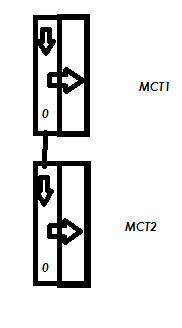
I have a setup in CADET-process with two MCT units (MCT1, MCT2) connected to each other via port 0 (channel 0). Both have an exchange parameter that allows storage in channel 1. There is no flow in channel 1.
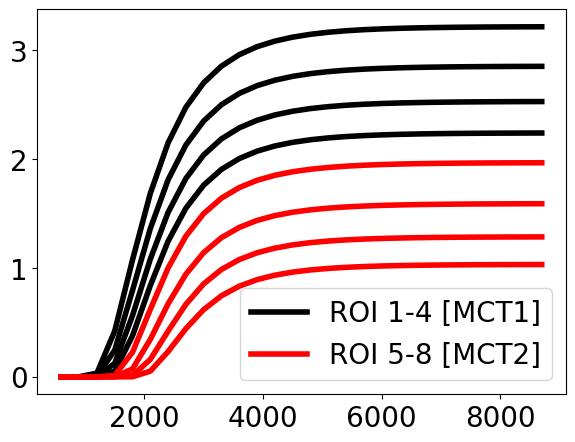
When I choose the same storage parameter for both units, I will get something like this for the bulk concentration at 8 spatial regions of interest, 4 of which are in the first unit (MCT1) and the other 4 in the second unit (MCT2). The concentrations of all channels are summed up, as this matches the data I observe:
When I choose a higher storage parameter for the second unit (MCT2) I now get something like this:
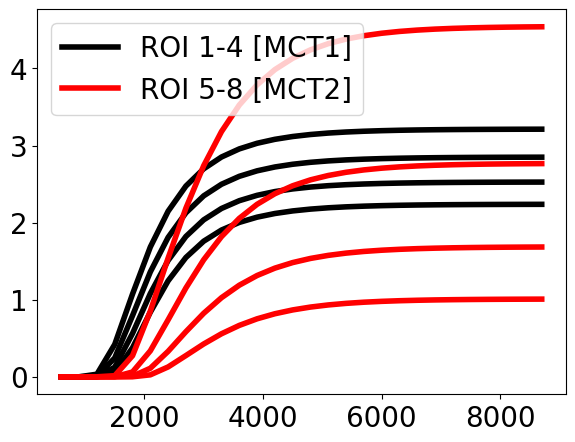
Now this is something I would never see in my data, as I am observing proton decay directly relating to the number of labeled C-atoms in my tracer and that cannot become suddenly more at later times.
I tried to get deeper into this issue and had a look at the outlet (which is just the last spacial cell) of the MCT1 unit:
Channel 0:
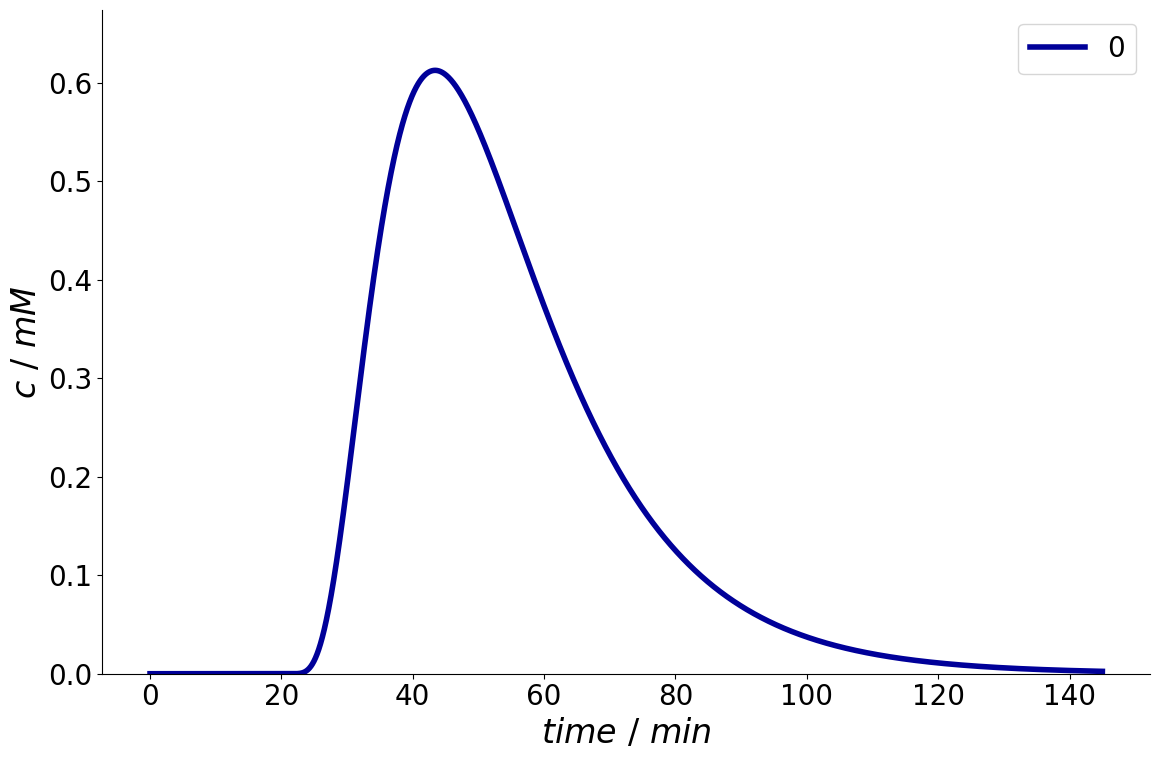
Channel 1:
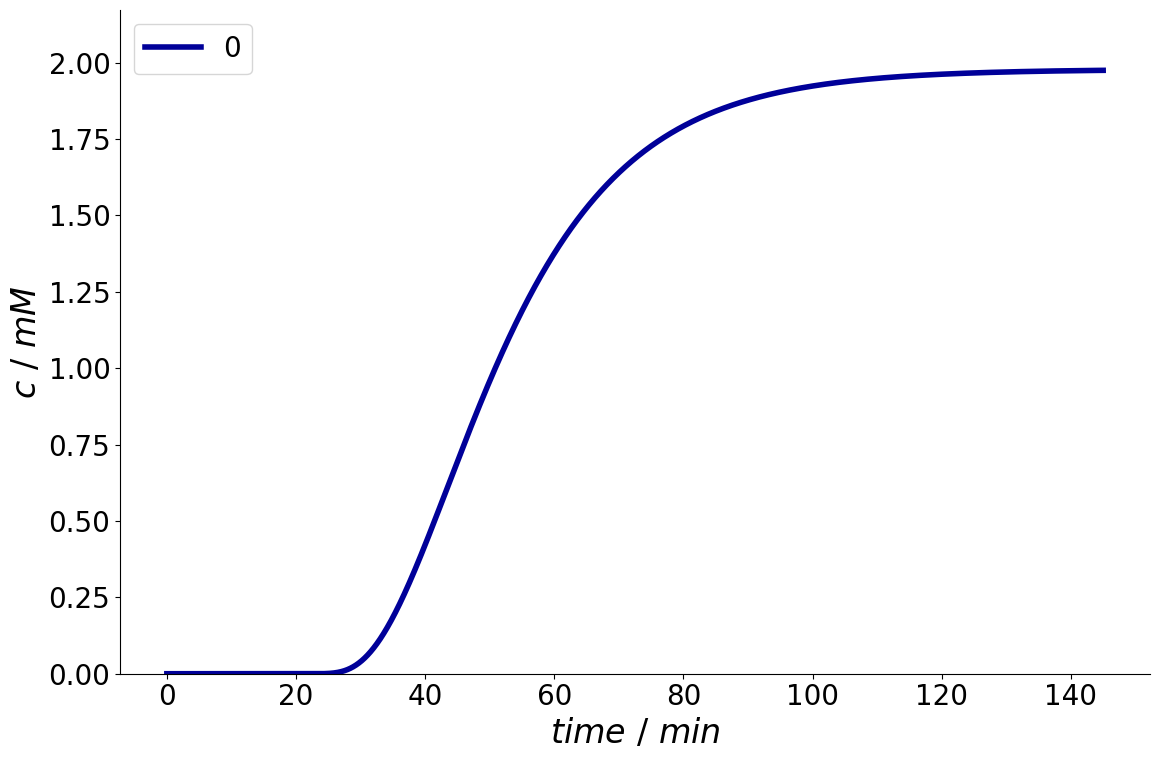
And I assume the problem has something to do with me not understanding, what the concentration in Channel 1 exactly means. I understand that, since there is no flow-rate there is kind of an accumulation happening. But still I don’t see, why for the upper example the concentration should rise to 2 mM/L when the original signal I put in was at 1 mM/L.
So now I am on the one hand trying to understand this issue more and on the other hand trying to find a solution to “equalize” several units behind each other with differing storage parameters.
Poplar_velocity_change_one_func_single_obj_problem.ipynb (299.1 KB)